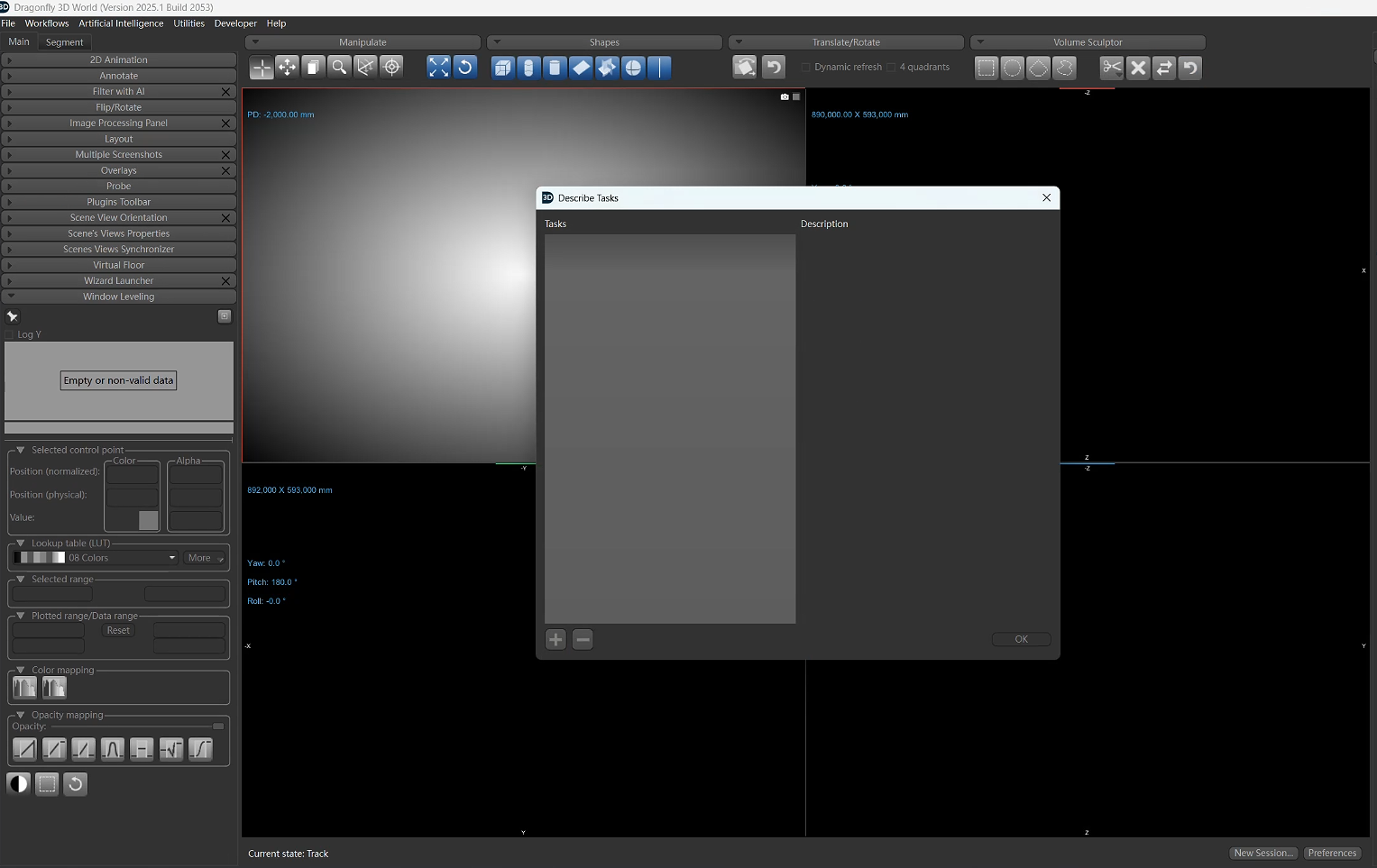
Dragonfly 3D World 2025.1
Free Download
Dragonfly 3D World 2025.1
Free Download
Developer:
License: One PC
System: Windows 10 11
Price: 60$
Download: Netdisk
Support: Remote operation control
Intelligent Separation of Structures | AI-Based Segmentation,Specialized applications in industries
Dragonfly 3D World 2025 introduces:
Segment Anything Model (SAM) Integration - enables rapid, one-click segmentation across diverse datasets, streamlining workflows and improving accuracy for complex structures.
Revamped Surface Determination - sub-voxel precision in mesh generation, improving CAD validation and defect analysis.
GPU-accelerated performance - significantly faster workflows for large datasets, reducing analysis time across industries.
Automated workflows - with macros and add-ons such as Auto-Executor, enabling reproducible, high-throughput inspection.
These features make 3D World 2025 an essential solution for applications ranging from additive manufacturing and advanced materials research to semiconductor inspection and electronic component reliability testing.
Intelligent Separation of Structures | AI-Based Segmentation
Automatically separates different phases of materials, particles, porosity, cracks, textures, and internal components using artificial intelligence algorithms and deep learning.
Quantitative Analysis of 3D Images | Quantitative 3D Image Analysis
extracts numerical information from volumetric data including volume, area, size distribution, morphology, density, and geometric properties of structures.
Medical & Bio Image Processing | Biomedical Image Processing
analyzes microscopic images, MRI, micro-CT, and biodata to examine cell structure, tissues, and medical specimens.
Material Microstructure Analysis | Material Microstructure Analysis
examines the phases of materials, grain sizes, particles, fibers, composites, and internal structures of engineering materials.
Porosity and Permeability Analysis | Porosity & Pore Network Analysis
Identify, measure, and analyze porosity network in rocks, ceramics, foams, batteries, and porous materials.
Surface Restoration & Mesh Production | Surface Reconstruction & Mesh Generation
converts 3D imaging data into surface and mesh models for reverse engineering, simulation, and numerical analysis.
Crack and Internal Defects Analysis | Crack & Defect Analysis
Identification and measurement of cracks, holes, impurities, and internal defects of parts without degradation of samples.
Large Data Processing | Large Volume Data Processing
Managing and processing very large 3D imaging datasets with optimized tools for rapid analysis.
Engineering Model Simulation and Preparation | Engineering Model Preparation
Preparation of 3D models extracted from images for use in FEM, CFD simulations, and engineering analyses.

Specialized applications in industries
Aerospace and automotive industries
in order to analyze the internal structure of parts, investigate production defects, control the quality of composite parts, alloys and parts manufactured by advanced production methods.
The battery and energy
storage industry is used to analyze the structure of electrodes, investigate the distribution of active substances, porosity, cracks, and structural changes in battery cells.
Materials
and metallurgical industries in order to study the microstructure of metals, composites, ceramics, polymers and analyze the relationship between internal structure and mechanical properties of materials.
Electronics
and semiconductor industries in order to investigate the internal structure of electronic components, fittings, soldering, microscopic cracks and manufacturing defects.
Geology and Reservoir
Engineering to analyze rock structure, porosity study, porous network, petrophysical properties and core analysis studies.
Biological and medical
sciences in order to analyze cell images, tissues, biosamples, bone structure, teeth, and 3D microscopic data.
R&D
laboratories in order to process advanced imaging data, develop new materials, fundamental studies, and extract quantitative information from complex samples.